If you’re a parent wondering, “What age should my child start coding?” the honest answer is: it is never too late to start, but earlier exposure can definitely help.
That does not mean every young child should jump straight into serious text-based programming. Coding for kids works best when the approach matches the child’s age, interest, and confidence level. A younger child may benefit from playful tools like ScratchJr or Blockly, while an older child may be ready to build games, apps, or websites with beginner-friendly programming languages.
The goal is not to rush children. The goal is to help them enjoy problem-solving, build confidence, and discover that they can create things with technology.
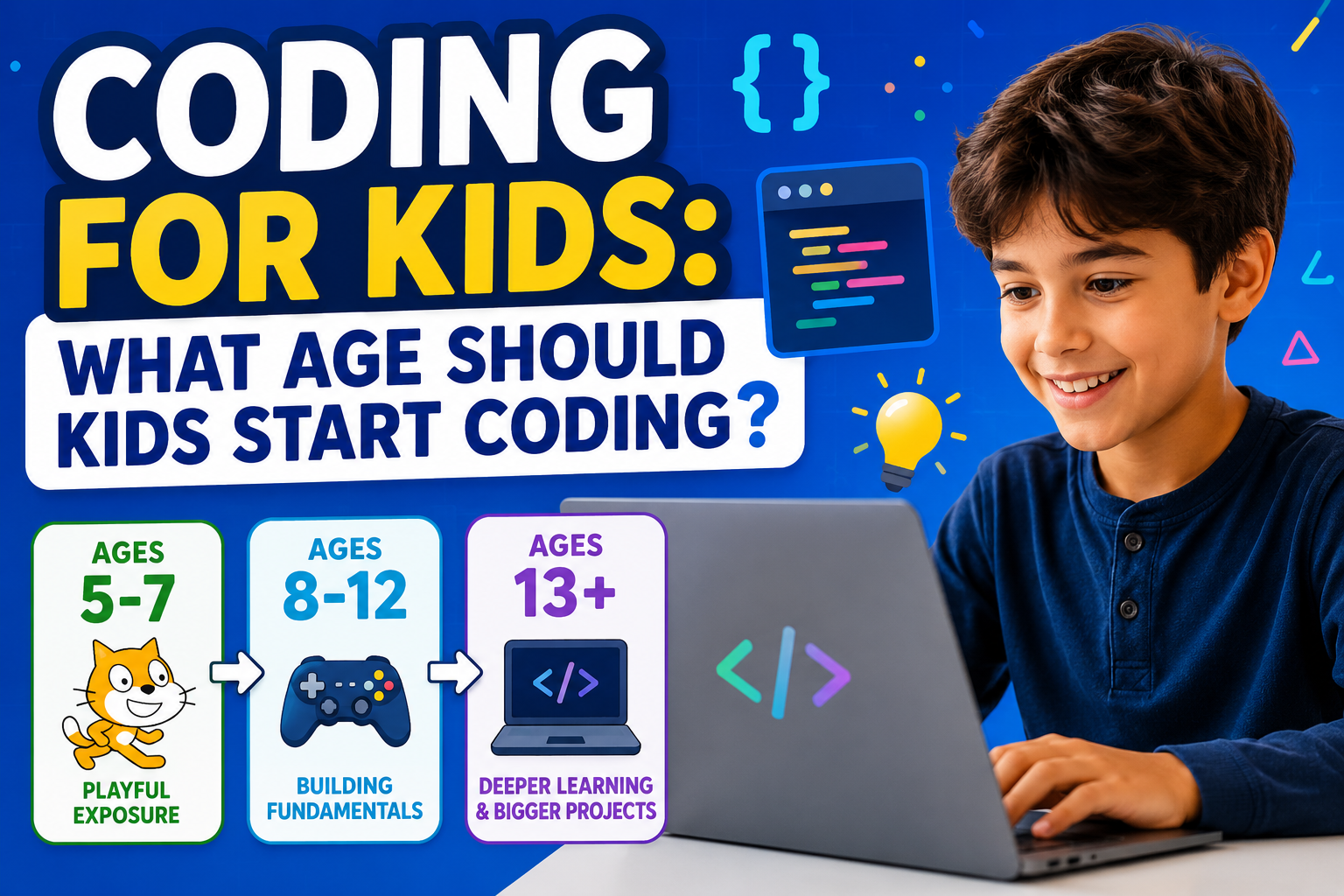
Children can begin learning coding concepts as early as ages 5-7, but at this stage coding should feel like a game.
Most children this age are not ready for serious text programming, and that is completely okay. Instead, they can learn early coding ideas through visual tools, simple puzzles, and creative activities.
At this age, kids can:
The goal is not to become a programmer yet. The goal is to start thinking like a problem-solver.
Ages 8-12 are often a great time for more structured coding. Many children in this stage can follow multi-step instructions, understand simple logic, and enjoy building projects that actually work.
This is when kids may begin creating:
For many children, this is a strong starting range for real coding skills because they are old enough to understand the basics, but still young enough to learn through play, creativity, and experimentation.
At this stage, the best coding experience should still be fun and hands-on. Children should not feel like they are sitting through a lecture. They should be making things, testing ideas, fixing mistakes, and seeing their projects come to life.
Teens are often ready for deeper coding concepts and more independent projects.
At this stage, kids may explore:
For some teens, coding may become a serious skill or even a future career interest. For others, it may simply become a useful creative tool. Both are valuable.
It is also important to remember that starting at 13 or later is not “too late.” Older beginners can learn quickly when they are interested and supported with the right projects.
The best age depends on the child and the approach.
A simple way to think about it is:
Earlier exposure is helpful because it gives children more time to get comfortable with logic, patterns, and problem-solving. But the experience has to feel age-appropriate. A curious 6-year-old using playful visual tools may enjoy coding, while a child who is pushed too quickly into difficult text programming may feel overwhelmed.
The key is not just age. The key is interest, timing, and the right learning environment.
Coding is often described as a technology skill, but it is also a thinking skill.
When kids learn to code, they practice breaking big problems into smaller steps. They learn to test ideas, notice patterns, fix mistakes, and keep improving.
They begin asking questions like:
These habits can help children in school, creative projects, and everyday problem-solving. Coding is not only about computers. It helps kids learn how to think clearly and keep going when something feels tricky.
A good first coding experience should feel encouraging, creative, and active.
Children learn best when they are building something they can see and interact with. That could be a simple animation, a game, a quiz, a website, or a small app. The project does not need to be complicated. It just needs to give them the feeling of, “I made this.”
A good beginner coding experience usually includes:
Mistakes are part of coding. In fact, debugging is one of the most valuable parts of learning. Children start to understand that when something does not work, it does not mean they failed. It means there is something to investigate and improve.
For younger children, visual coding tools like ScratchJr, Blockly, or Scratch are often the best place to begin. These tools let kids learn important coding ideas without worrying about spelling, punctuation, or complex syntax.
For children who are ready for typed coding, Python can be a great first programming language. Python is easier to read than many other languages, which helps beginners focus on the main ideas of coding.
Scratch is great for playful exposure and creative projects. Python is great for children who are ready to build more structured coding fundamentals.
Both can be excellent starting points when used at the right time.
Parents sometimes feel pressure to prepare their kids for the future. But coding should not begin with fear or stress.
A better starting point is curiosity.
Can your child make a simple game? Can they solve a small coding puzzle? Can they change something in a project and see what happens? Can they feel proud of building something themselves?
That feeling builds confidence. And when kids feel confident, they are much more likely to keep learning.
If your child is in the “building coding fundamentals” stage, we are building Bright Coders to help make that step as fun and encouraging as possible.
Our Intro to Python course is designed for children ages 8-13 who are ready to try beginner text-based coding through hands-on projects, quizzes, and game-building. We want kids to experience the joy of making something themselves, not just memorizing code.
The course is online, beginner-friendly, and currently 2 months free so your child can try it and see if it is the right fit.
Join our 2-month free course and help your child explore coding in a fun, supportive way.