Disclosure: I run Bright Coders, so I have a stake in how this comparison lands. I have tried to write this the way I would explain it to a friend — including the situations where Tynker is genuinely the better fit. Take my perspective with that in mind.
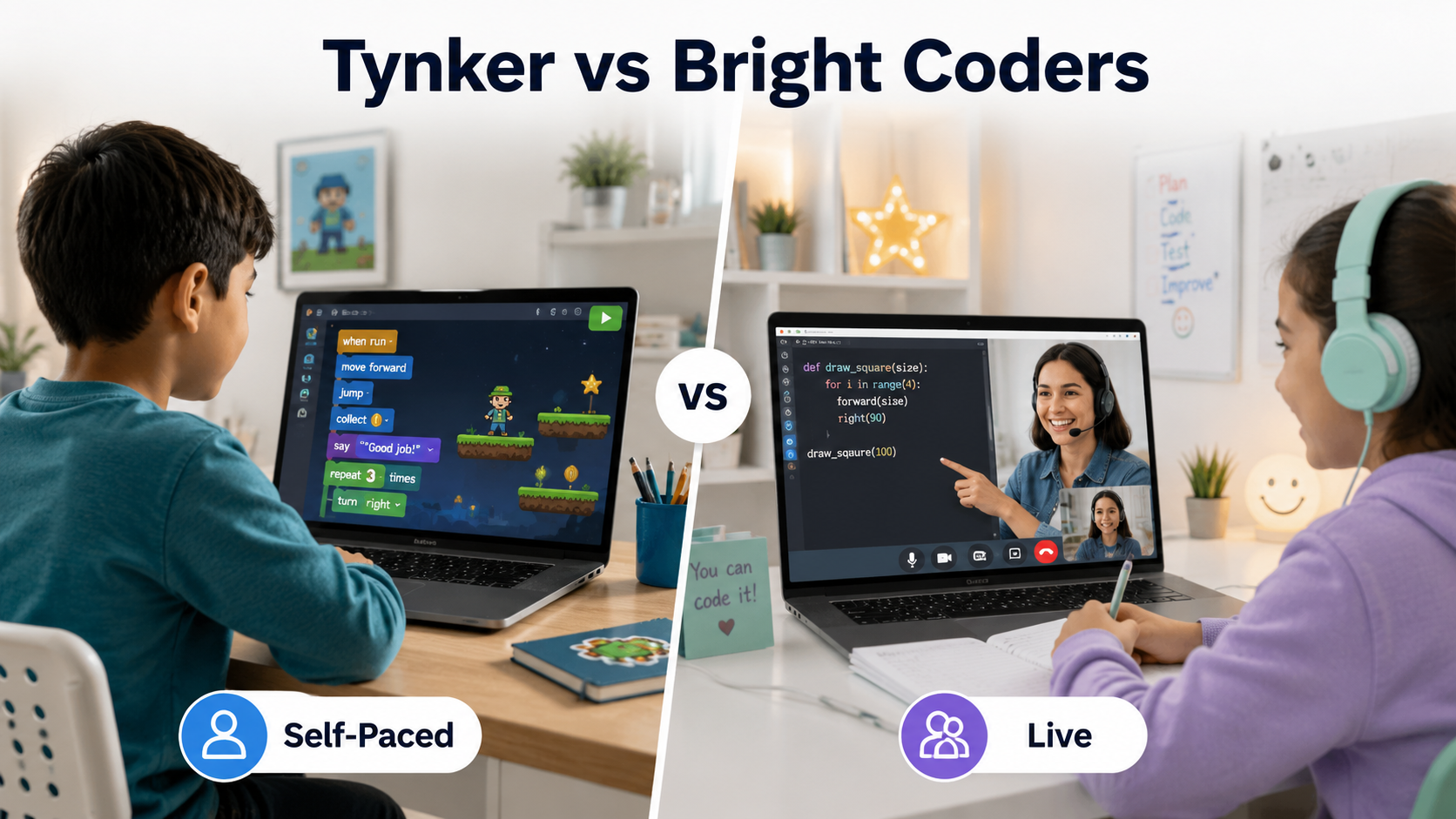
Tynker and Bright Coders teach the same languages — Python, JavaScript, and more — but they are built on completely different assumptions about how kids learn. Tynker is a self-paced software platform: your child logs in, works through lessons on their own, and progresses when they are ready. Bright Coders is a live online program where a real teacher leads every session, answers questions in the moment, and keeps students moving forward when things get hard.
The content is similar. The experience is not. The right choice comes down to one question: what happens when your child gets stuck?
I want to be direct about this, because I think it is the most useful thing I can tell you: Tynker is a genuinely well-built platform, and for the right learner, it works.
Tynker is a strong fit if…
• Your child is highly self-motivated. Tynker has thousands of hours of content — from block coding all the way through Python, JavaScript, and data science. A child who genuinely loves puzzles and will push through frustration on their own can go very far on Tynker without ever needing a teacher.
• You want flexibility over structure. Because it is self-paced, your child can log in at midnight, skip ahead, revisit lessons, or take a week off without missing anything. There are no scheduled sessions and no commitment to show up.
• You want a lower monthly cost. Tynker is a software subscription, not a class. At around $15 to $18 per month (billed quarterly or annually), it is one of the most affordable options in the market.
Most kids who start a self-paced coding app are excited for the first few weeks. The problems are manageable, the progress feels fast, and the gamification keeps them coming back. Then they hit a wall.
The wall is usually a bug they cannot find, a concept that did not click, or a project that suddenly feels too hard. In a self-paced app, there is no one to help them through it. So they close the app. And they often do not open it again.
Bright Coders is a strong fit if…
• Your child needs a live teacher to stay on track. Every Bright Coders session is led by a real instructor. When a student gets stuck — and they will — the teacher is right there to help them through it before frustration turns into quitting. That moment of being unstuck by someone who knows what they are doing is what keeps kids coming back week after week.
• You want your child to actually finish what they start. Self-paced programs have high dropout rates, not because the content is bad, but because there is no one holding the thread when things get difficult. Live instruction creates accountability in both directions — the teacher notices when a student is struggling, and the student shows up because someone is expecting them.
• Your child is ready to write real code. Bright Coders teaches Python and JavaScript directly, with a live teacher to help debug errors and explain concepts in the moment. Learning text-based syntax without someone to help when things break is one of the most common reasons kids give up on coding.
• You want to try it thoroughly before committing. Tynker offers a 30-day money-back guarantee, which requires you to pay upfront and request a refund if it does not stick. Bright Coders offers a completely free 8-session introductory course — no credit card required. That is two full months of live classes to find out whether coding is something your child actually wants to pursue before you spend anything.
This is the most practically important difference between the two programs, and I want to be honest about it even though I have an obvious interest in the answer.
Coding gets hard. It gets hard for adults, and it gets hard for kids. The moment it gets hard is also the most important moment in a child's coding education — because how that moment is handled determines whether they keep going or give up.
In a self-paced platform, a stuck child has a few options: search the forums, rewatch a tutorial, or quit. Most kids quit. Not because they are not capable, but because being stuck and alone is genuinely demoralizing.
In a live class, a stuck child has a teacher. The teacher sees the bug. The teacher explains why it happened. The student fixes it, and that small victory — solving something that felt impossible thirty seconds ago — is exactly what builds confidence and keeps kids coming back.
Tynker is excellent software. But software cannot read the room. It cannot tell the difference between a child who is productively challenged and a child who is about to close the tab. A live teacher can.
If your child is the kind of person who watches programming tutorials for fun and builds things on their own, Tynker's self-paced format may suit them perfectly. For everyone else, having a teacher in the room when things get hard makes all the difference.
Live instructor, real Python or JavaScript, no credit card required. Two months of classes before you pay anything.
Yes, for the right learner. Tynker is a well-built platform with a wide range of content, from beginner block coding all the way to Python and JavaScript. At around $15 a month, it is one of the most affordable options available. The main limitation is that it is entirely self-paced — there is no live teacher to help when a child gets stuck, which is the most common reason kids stop progressing on self-paced platforms.
It depends on what you need. If you want another self-paced platform, Scratch (free) and CodeMonkey are worth considering. If your child has been struggling to stay motivated on self-paced apps and needs a live teacher to keep them on track, Bright Coders is a strong alternative — free 8-session intro, then $78–$130 per month to continue.
Yes. Tynker's curriculum includes Python and JavaScript courses, not just block coding. The challenge is that learning text-based syntax on your own — without a teacher to help debug errors in real time — is significantly harder than learning it in a live class. Many students find that the jump from blocks to text code is where they stall on self-paced platforms.
Yes. Bright Coders offers a completely free 8-session introductory course — roughly two months of weekly live classes — with no credit card required. Students write real code from the first session. You only pay to continue if your child wants to keep going.