If your child is ready to move beyond Scratch or other visual coding tools, you might start hearing about Python and JavaScript.
Both are popular. Both are useful. Both can be great first text programming languages for kids.
So which one should your child learn first?
My honest answer is: it depends on what kind of projects will keep your child interested.
Python is usually easier to start with because it is clean and readable. JavaScript can feel harder at first because it often comes together with HTML and CSS, which means there are more details to remember. But once children understand how HTML, CSS, and JavaScript work together, they can create very tangible projects quickly: websites, animations, buttons, games, and things that move on the screen.
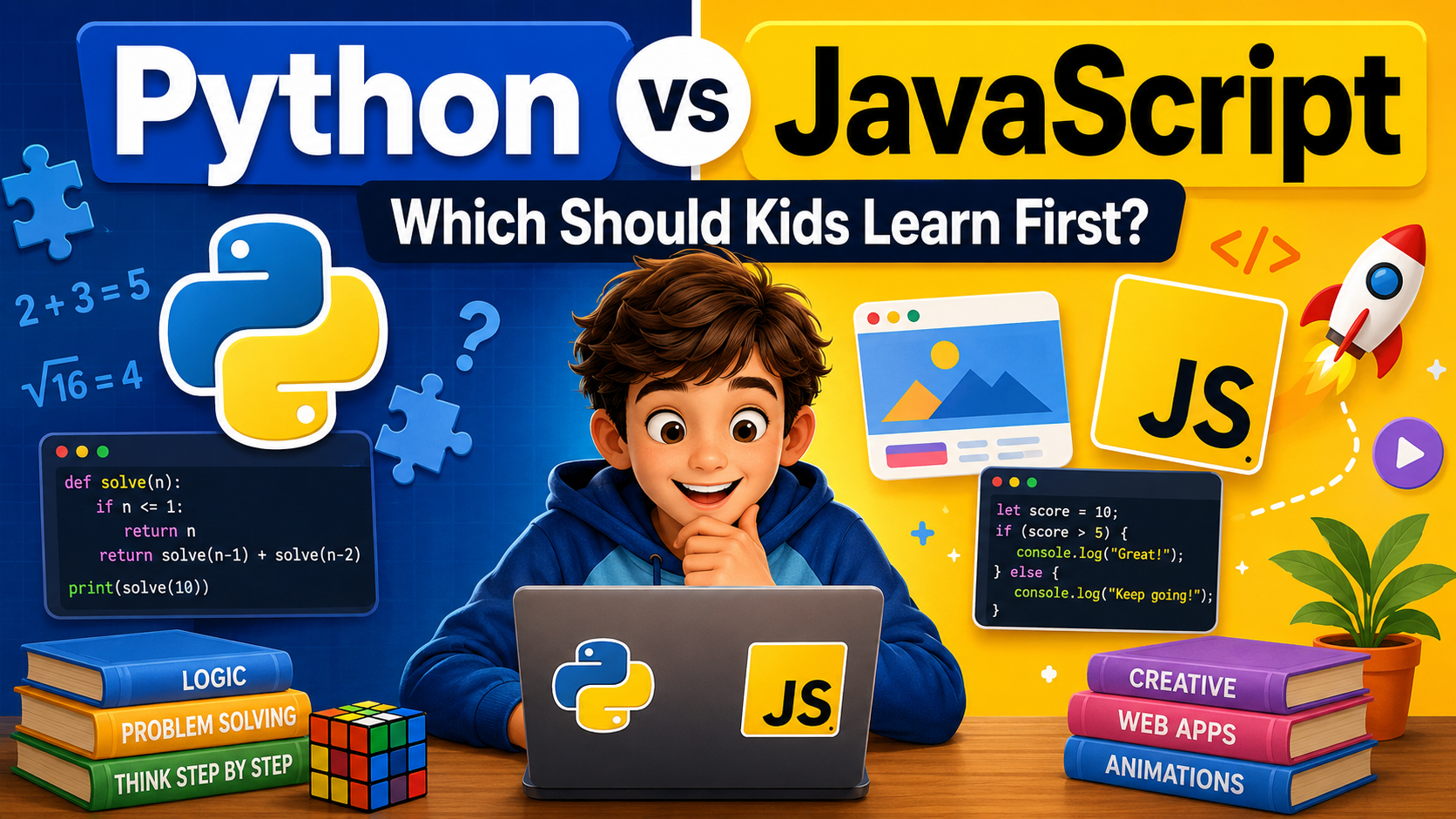
If your child likes math, puzzles, logic, or step-by-step problem-solving, Python is a great place to start.
If your child likes design, animation, websites, or creative visual projects, JavaScript is absolutely worth trying.
Python is one of the most popular beginner programming languages because it feels less intimidating than many other languages.
The code is usually easier to read. There are fewer symbols to remember. Children can often look at a simple Python program and understand what is happening.
That matters a lot when a child is just starting text programming. At the beginning, they are already learning how to think like a programmer. They do not need every line of code to feel like a puzzle just to type correctly.
With Python, kids can learn important coding ideas like:
Python is also used in real-world fields like data analysis, automation, science, artificial intelligence, and app development. Kids do not need to worry about those advanced topics right away, but Python gives them a strong foundation that can grow with them.
Python can be used to create visual projects. There are modules like Tkinter for simple interfaces and Pygame for games. So it is definitely possible for kids to build something they can see and interact with using Python.
However, Python is often more naturally suited for logic, problem-solving, data, automation, and analysis. Compared with web projects, it may take a little more setup before children can create something that feels immediately tangible on the screen.
That does not make Python less valuable. In fact, this is one reason Python is so strong for learning coding fundamentals. It helps children focus on the logic of programming without too many extra design details.
But if your child is mostly motivated by visual output, animation, or building something they can instantly show in a browser, JavaScript may feel more exciting at first.
JavaScript is the language of the web. It is what makes websites interactive.
That means JavaScript can be very fun for kids who want to make things they can see and click. A child can change colors, make buttons work, build a small quiz, animate an object, or create a simple web game.
For some kids, that visual feedback is incredibly motivating. They write code, refresh the page, and immediately see something change.
With JavaScript, kids can build:
Once children understand the relationship between HTML, CSS, and JavaScript, it becomes much easier to create projects that move and respond. HTML gives the page structure, CSS controls how it looks, and JavaScript controls what happens.
The exciting part of JavaScript is also what can make it distracting for beginners.
When children learn JavaScript for web projects, they are often learning three things at once:
This can be motivating because the results are visual. But it can also pull attention away from the pure computer science side of coding.
A child might spend a lot of time adjusting colors, layout, fonts, buttons, or animations before fully understanding the programming logic underneath. That is not necessarily bad. Creative exploration is part of learning. But it does mean JavaScript can feel less direct if the goal is to focus deeply on coding fundamentals.
So JavaScript is a wonderful choice for creative projects, but it helps to have a learning path that keeps the programming concepts clear.
For most kids, Python is easier to start.
Python tends to have cleaner syntax, which means children can focus more on the logic of coding and less on punctuation, brackets, and page setup.
For example, if a child is learning loops or conditions for the first time, Python usually lets them see the idea more clearly. That can make the early learning curve feel smoother.
JavaScript is not “too hard” for kids, but it often asks them to remember more at the beginning. If they are also learning HTML and CSS, they may need time to understand which part controls the page, which part controls the design, and which part controls the action.
So if the goal is to build coding fundamentals with less friction, Python is often the simpler first choice.
JavaScript often feels more creative right away because children can build things directly in a browser.
They can make a button change color. They can move an object across the screen. They can build a small game or interactive story. The result feels tangible.
Python can also be creative, especially with tools like Pygame. But depending on the setup, Python may feel a little less immediate than changing something on a webpage and seeing it respond.
This is where your child’s personality matters.
Some kids enjoy the clean logic of Python. Others light up when they can design something visual and interactive. Neither path is better. The better path is the one your child wants to keep exploring.
Python is a great fit for children who enjoy:
Because Python is readable, it gives kids more room to think about the problem itself. They can focus on what they want the program to do, instead of getting stuck on too many symbols or web development details.
This makes Python especially helpful for building strong coding fundamentals.
JavaScript is a great fit for children who enjoy:
For some children, JavaScript makes coding feel real because they can see the result in front of them. If your child loves making things look interesting or interactive, JavaScript can be a wonderful starting point.
One thing I would really emphasize to parents is this: the first language is not a permanent decision.
If a child learns one programming language well, it becomes much easier to learn another later. The details change, but the thinking transfers.
Python and JavaScript both teach children how to use:
The spelling and symbols may be different, but the core ideas are very similar.
So instead of worrying too much about choosing the perfect first language, it is usually better to choose one, stick with it for a while, and build real projects.
Once a child understands how coding works, they can catch up on other languages much more easily.
If your child enjoys coding, then yes, learning both can be valuable over time.
Python is excellent for building logic, problem-solving, games, automation, and eventually topics like data or AI.
JavaScript is excellent for websites, interactive projects, web games, and anything that runs in a browser.
But they do not need to learn both at the same time.
It is usually better to go deep enough in one language to build confidence. Then the second language feels much less scary.
Here is a simple way to decide:
Both Python and JavaScript are excellent choices for coding for kids.
The most important thing is not picking the “perfect” language. The most important thing is helping your child start with something fun, clear, and encouraging enough that they want to keep going.
If your child is ready to start text programming, we are building Bright Coders to help children learn coding fundamentals in a fun and encouraging way.
Our Intro to Python course is designed for children ages 8-13 who are ready to try beginner text-based coding through hands-on projects, quizzes, and game-building.
The course is online, beginner-friendly, and currently 2 months free so your child can try it and see if it is the right fit.
Join our 2-month free course and help your child explore coding in a fun, supportive way.
If your child is more interested in websites, design, animation, or interactive visual projects, we also offer an Intro to Web Programming course.
In this course, children learn the basics of HTML, CSS, and JavaScript so they can understand how web pages are built and how to make them move, respond, and feel interactive. It is a great fit for kids who are excited by creative projects they can see and share.